GEO vs SEO: The Definitive 2026 Guide to Ranking in Google and AI Search
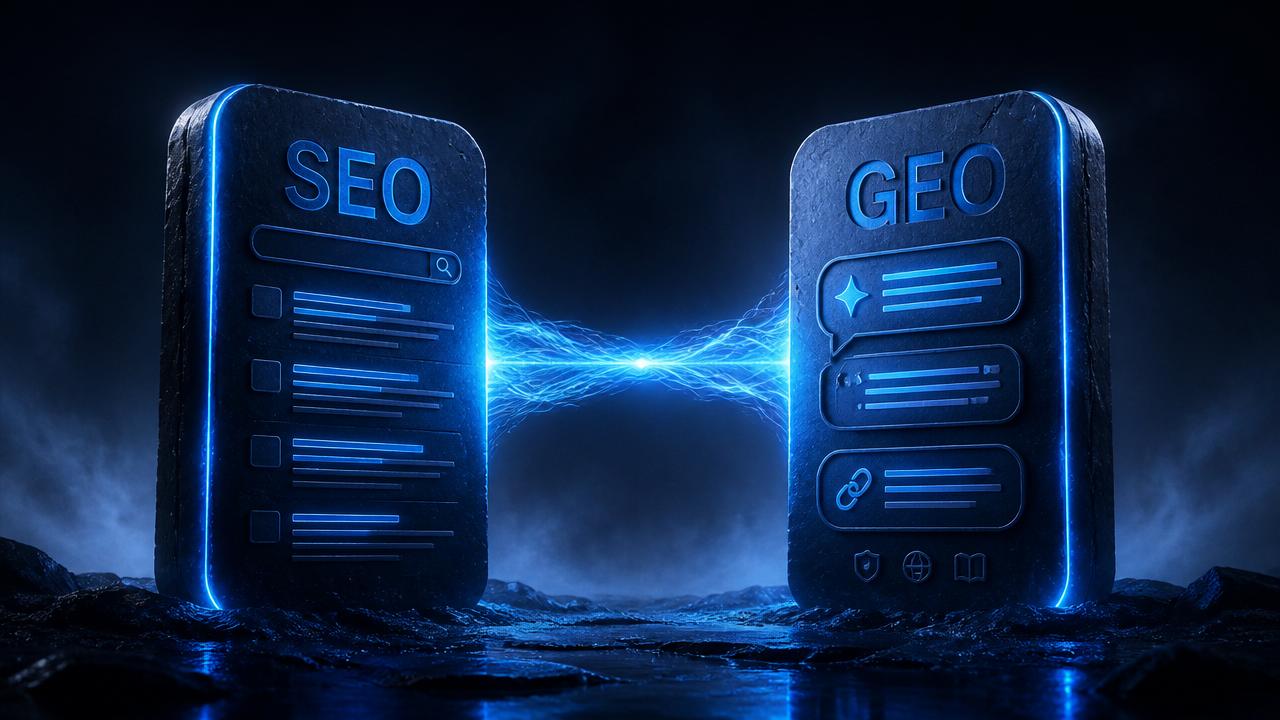
GEO vs SEO is the single most important strategic question in digital marketing right now. Search is no longer one channel — it is two, and they behave differently. Classic SEO optimizes for Google's blue-link SERP. Generative Engine Optimization (GEO) optimizes for the synthesized answers ChatGPT, Perplexity, Gemini, Claude, and Google's AI Overviews return instead of a list. The brands winning in 2026 are treating them as first-class siblings — not one as an afterthought bolted onto the other. This guide breaks down every real difference, where they overlap, and the exact unified playbook AtomikEngine ships for clients who want to dominate both surfaces.
What is SEO?
SEO — Search Engine Optimization — is the practice of ranking web pages higher in traditional search engine results (Google, Bing, DuckDuckGo). The unit of ranking is a page, and the goal is to appear in the top ten organic results for high-intent queries. It rewards keyword targeting, backlinks, page speed, mobile usability, and demonstrable topical authority. It's been the dominant discipline in digital marketing for 25 years and still drives the majority of trackable organic traffic for most businesses.
What is GEO?
GEO — Generative Engine Optimization — is the practice of structuring your content, technical stack, and citation profile so large language models cite you as the source when they synthesize answers. The unit of ranking is a passage, not a page. Instead of ten blue links, you get one synthesized answer with three or four citations underneath — and if you're not in that citation strip, you don't exist for that query. GEO rewards semantic clarity, structured data, extractable facts, expert authorship, and co-occurrence across the sources LLMs trust (Reddit, Wikipedia, high-authority publishers, top-ranking pages).
GEO vs SEO: the core differences at a glance
- Ranking unit: SEO ranks pages; GEO ranks passages and facts.
- Result format: SEO returns a list of ten links; GEO returns a single synthesized answer with 3–4 citations.
- Winner dynamics: SEO distributes clicks across positions 1–10; GEO is winner-take-most — the citation strip is tiny.
- Content style: SEO rewards comprehensive long-form; GEO rewards discrete, self-contained, extractable answers.
- Authority signals: SEO weights backlinks heavily; GEO weights citations, brand mentions, and co-occurrence across trusted sources.
- Measurement: SEO uses stable rank tracking and Search Console; GEO uses prompt-based citation tracking (Profound, Peec AI, Otterly) because there is no stable SERP.
- Update cadence: SEO SERPs shift on major algorithm updates; GEO citation sets shift weekly as models retrain.
- Technical priority: Both need SSR and clean HTML, but GEO is punished harder by client-side-only React apps because AI crawlers give up faster than Googlebot.
Where GEO and SEO overlap
The overlap is bigger than most agencies admit. A page engineered for GEO is almost always a better SEO page too, because the underlying signals reinforce each other:
- Server-side rendered, fast-loading HTML helps both Googlebot and GPTBot.
- Structured data (FAQPage, HowTo, Article, Organization schema) feeds both Google rich results and the knowledge graphs LLMs cross-reference.
- Clear H2 hierarchy and direct-answer paragraphs improve featured-snippet capture in Google and citation extraction in ChatGPT.
- Authoritative backlinks still drive both — Google uses them for ranking, and LLMs use the same graph to decide which domains deserve citation weight.
- Expert authorship and E-E-A-T signals matter for both — Google demoted thin content years ago, and LLMs actively de-weight AI-generated fluff.
The mistake is assuming they're identical. They share a foundation, but the top of the funnel diverges sharply.
Where they diverge — and why it matters
SEO rewards depth. A 3,000-word pillar page targeting one head term can dominate Google for years. GEO rewards specificity. That same pillar page underperforms in AI search unless it's broken into cleanly-chunked, self-contained sections that a retrieval-augmented pipeline can lift verbatim.
SEO tolerates ambiguity. "Our software helps teams work smarter" can rank if the domain has enough authority and the on-page signals are otherwise strong. GEO punishes ambiguity. LLMs ignore vague marketing copy and cite the page that says "HubSpot's free CRM supports up to 1,000,000 contacts and integrates with Gmail, Outlook, and Slack." Facts get cited; adjectives do not.
SEO measurement is mature. Rank trackers, Search Console, and analytics give you a defensible number. GEO measurement is emerging. There is no stable SERP, so you have to run scheduled prompts through each LLM weekly and log whether your domain appears in the citation strip. Tools like Profound and Otterly automate this; rolling your own with the OpenAI, Anthropic, and Perplexity APIs is straightforward if you want full control.
Which one should you invest in first?
For most B2B and services businesses in 2026, the honest answer is: both, and the same content usually serves both if it's engineered correctly. A pragmatic sequencing:
- If you have zero organic presence: start with SEO fundamentals (technical foundations, keyword-targeted pillar pages, internal linking). Google is still the majority of trackable traffic, and the foundational work makes you GEO-eligible for free.
- If you already rank on Google but are invisible in ChatGPT/Perplexity: your content is probably too vague or too long-form to extract cleanly. Rewrite existing pages to lead each H2 with the question, follow with the direct answer in the first sentence, and add a stat or definition. That single change often produces citations within 4–8 weeks.
- If you're launching a new brand: build for both from day one. Skipping GEO now means rebuilding your content library in 18 months when AI search overtakes classic search for high-intent research.
The unified GEO + SEO playbook we run for clients
This is the exact stack AtomikEngine ships. Every layer serves both surfaces.
1. Technical foundation
- Server-side rendered HTML on edge infrastructure (we default to TanStack Start on Cloudflare Workers). Both Googlebot and GPTBot render it identically and instantly.
- Verified in Google Search Console AND Bing Webmaster Tools. Bing feeds a huge share of AI citations; skipping it kills GEO reach.
- Explicit robots.txt whitelisting GPTBot, PerplexityBot, ClaudeBot, Google-Extended, and Bingbot. Many CMS defaults block them silently.
- An llms.txt file at the root, pointing LLMs to the canonical pages and describing what the site is about.
- Perfect Core Web Vitals (LCP under 1.5s, CLS near zero). Speed is a Google ranking factor and a de facto GEO factor because slow pages get dropped from crawl budgets.
2. Content architecture
- Pillar pages for topical authority (SEO wins here). One comprehensive resource per topic cluster, deeply internally linked.
- Every H2 opens with the question a user would type or ask, followed by a direct answer in the first sentence (GEO wins here). Both surfaces reward this pattern.
- Definition lists, comparison tables, and bulleted lists everywhere they're natural. LLMs disproportionately cite structured formats because they map cleanly to how answers get formatted.
- Original data, benchmarks, and proprietary statistics. These are the highest-leverage GEO asset because no one else has the number, so the citation is unique to you.
3. Structured data
- FAQPage, HowTo, Article, Product, Service, and Organization JSON-LD on every relevant page.
- BlogPosting schema on every article with author, publisher, and datePublished.
- Breadcrumb schema on every internal page for site-structure signals.
4. Authority building
- Traditional link building for SEO (guest posts on high-DA industry sites, digital PR, resource-page outreach).
- Reddit presence in the subreddits your buyers live in. ChatGPT ingests Reddit heavily and cites it directly.
- Wikipedia entries where notability supports them. The single highest-weight citation source for most LLMs.
- Being quoted in existing top-ranking articles for your target queries. When the LLM synthesizes, your name comes with the citation.
5. Measurement stack
- Google Search Console + GA4 for classic SEO (impressions, clicks, positions, conversions).
- Weekly prompt monitoring across ChatGPT, Perplexity, Claude, and Gemini for GEO (citation frequency, position in strip, which facts get lifted).
- Server-side attribution so you can see when a lead comes from an AI-search referral vs. classic organic.
Common mistakes to avoid
- Treating GEO as a one-time project. Citation sets shift weekly; this is an always-on discipline.
- Publishing thin AI-generated content. LLMs detect it and de-weight the source. Original voice, expert quotes, and specific numbers are the antidote.
- Chasing head terms exclusively. Long-tail, question-shaped queries are where GEO wins fastest because the answer format maps directly to how LLMs synthesize.
- Blocking AI crawlers to "protect" your content. You're not protecting it — you're guaranteeing you'll never be cited when someone asks about your category.
- Measuring GEO with SEO tools. Rank trackers don't work for ChatGPT. Use prompt-based tools or build your own with the model APIs.
The bottom line
GEO vs SEO is a false dichotomy. They're two output surfaces powered by the same underlying signals — retrievable technical foundations, parseable content structure, and demonstrable authority. Brands that engineer for both compound faster than brands optimizing for either alone, because every layer of the stack pulls double duty. The ones losing are the ones still shipping 2015-era SEO content and calling it a strategy.
If you want the full stack — edge-rendered site, LLM-friendly content architecture, structured data, citation-building, and weekly GEO + SEO tracking — that's what AtomikEngine ships. Both search surfaces are the same customer at different moments; win both and you own the funnel.
Atomik Engine Services
Engineered growth, end to end.
We ship the systems behind everything in this article — websites, SEO/GEO, and AI automation — on a modern edge stack with fixed scope and transparent pricing.
Ready to build?