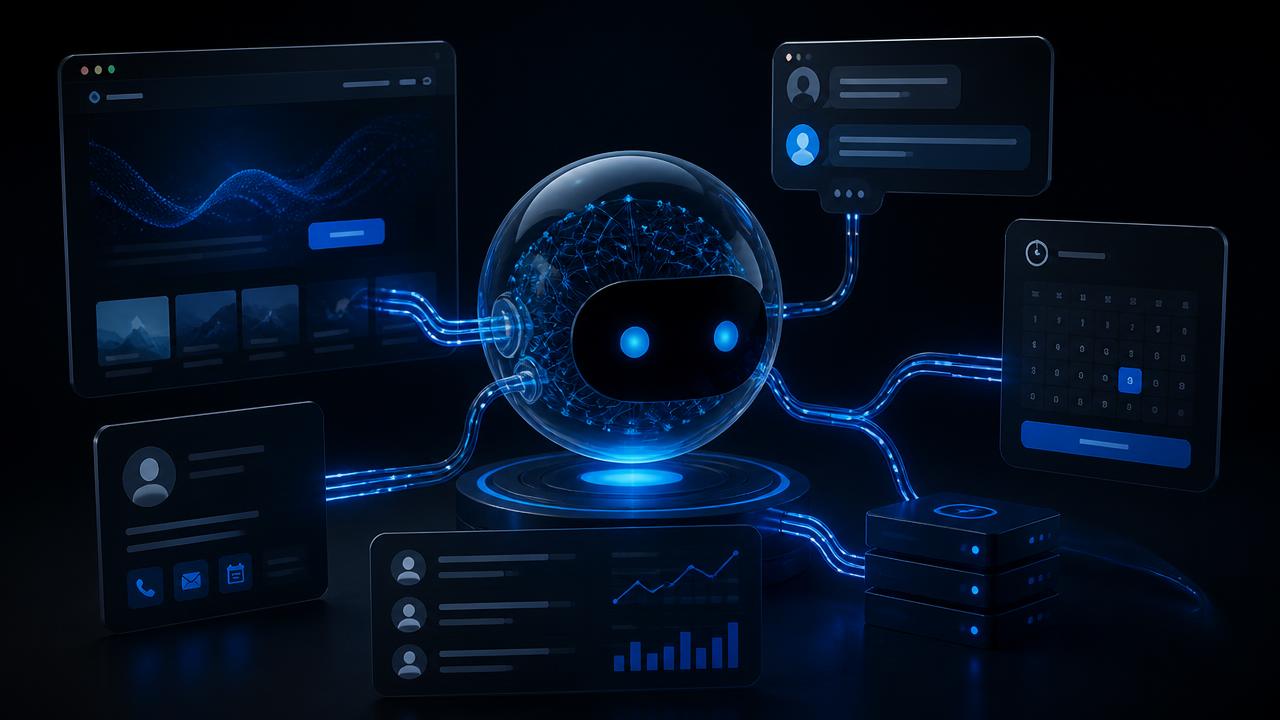
Benefits of AI Chatbots on Websites: The 2026 Guide to More Leads, Lower Costs, and 24/7 Sales
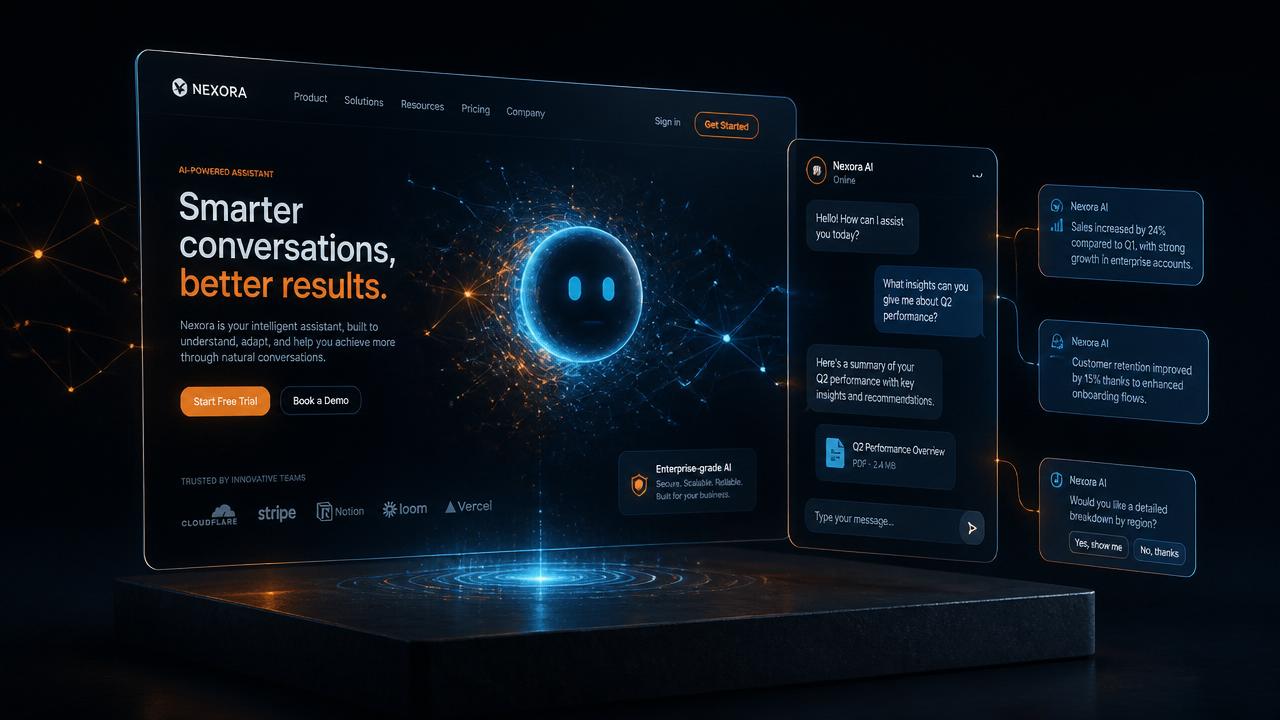
AI chatbots stopped being a novelty in 2024. In 2026 they are the single highest-ROI feature you can add to a business website — outperforming a redesign, a paid campaign, or a new landing page on most attribution models we see. This guide covers exactly why: the measurable benefits, the numbers behind them, where AI chat fails, and the rollout plan we use to ship one that actually moves revenue.
The short answer: what an AI chatbot does for your website in 2026
- Captures 30–70% more leads by engaging visitors who would have bounced.
- Answers 60–80% of routine customer questions without a human, 24/7.
- Cuts support costs by $8–$25 per resolved conversation vs. email or phone.
- Books qualified meetings directly into your calendar while the visitor is still on-page.
- Feeds structured intent data back to your CRM and analytics stack.
- Improves on-site dwell time and engagement — both signals modern search engines and AI answer engines (ChatGPT, Perplexity, Google AI Overviews) use to rank and cite pages.
Everything after this section explains where those numbers come from and how to actually capture them.
1. More leads from the traffic you already have
The average B2B website converts 2–3% of visitors into a lead. A well-scoped AI chatbot pushes that to 4–6% by intercepting the 70%+ of visitors who never fill out a form. Instead of forcing a visitor to hunt for pricing or a contact page, the chatbot answers their question, qualifies intent, and offers the next step in-line: book a call, request a quote, or download the resource.
This is not a pop-up nag. Modern chatbots use context — the page the visitor is on, referrer, time on site — to open with a relevant question. On a pricing page: 'Want a quick estimate for your use case?' On a services page: 'Which service are you exploring?' The lift shows up in the first 30 days because it monetizes traffic you were already paying for.
2. 24/7 sales and support — without hiring
More than half of B2B buying research happens outside 9-to-5. An AI chatbot handles evenings, weekends, and holidays with the same voice as your best salesperson. For service businesses, this alone often justifies the build — every lead captured at 11pm on a Saturday is a lead your competitors missed.
For support, the math is even more direct. Zendesk's own 2025 benchmark data puts the fully-loaded cost of a human-handled email ticket at $8–$25 and a live chat at $10–$40. A well-trained AI chatbot resolves 60–80% of routine questions autonomously — refund status, shipping windows, appointment changes, product specs — at a marginal cost of pennies per conversation.
3. Faster response times = higher conversion
Harvard Business Review's landmark lead-response study found companies that respond to a web lead within 5 minutes are 9× more likely to convert that lead than companies that wait 30 minutes. The median human response time is still over an hour. An AI chatbot's response time is under 3 seconds. That gap is the single largest reason chat-first sites outperform form-first sites on the same traffic.
4. Better lead qualification before a human ever touches it
The best chatbots do more than answer — they qualify. A short, conversational sequence collects budget, timeline, use case, and decision-maker status, then routes the lead: hot leads book a meeting directly, warm leads land in a nurture sequence, and out-of-scope inquiries get a helpful redirect. Your sales team stops wasting hours on unqualified pipeline.
5. Personalization at scale
AI chatbots read context (page, industry, prior interactions) and adapt tone, examples, and offers on the fly. A visitor from a law firm sees case studies about law firms. A visitor comparing pricing gets an ROI calculator. This is the same personalization Amazon and Netflix have used for a decade, finally accessible to SMBs without a data-science team.
6. On-site AI search that actually finds things
Traditional site search is broken for most sites — 40%+ of searches return zero relevant results. An AI-powered on-site search understands intent ('how do I cancel' → billing help doc, not a keyword match on 'cancel'). Better search means less bounce, more pages per visit, and more conversions from users who came in with a specific question.
7. SEO and GEO benefits (yes, really)
AI chatbots indirectly improve organic visibility in three ways: (1) they increase dwell time and pages-per-session — engagement signals Google and Bing use in ranking; (2) they surface long-tail questions your content should answer, feeding your content roadmap; (3) they generate structured Q&A conversations that, when logged and repurposed into FAQ pages with FAQPage schema, get cited by AI answer engines like ChatGPT, Perplexity, and Google AI Overviews. This is the intersection of SEO and GEO (Generative Engine Optimization) — and it's how modern sites earn AI citations without gaming anything.
8. Cost savings that compound
A single mid-tier AI chatbot deployment ($3,000–$8,000 to build, $50–$300/month to run) replaces roughly 20–40 hours of human tier-1 support and sales-qualification work per week. At even a modest fully-loaded labor cost, that's a payback window under 90 days on nearly every deployment we've shipped. The savings compound month over month — the chatbot doesn't take vacation, quit, or need retraining when it gets better.
9. Data you couldn't collect any other way
Every conversation is a labeled intent signal. Which products get the most questions. Which objections come up before a purchase. Which competitor names visitors mention. Which features they ask about that you haven't built yet. This is the highest-quality voice-of-customer data a marketing team can get — and it arrives structured, timestamped, and searchable.
10. A better mobile experience
60%+ of web traffic is mobile in 2026, and mobile forms are the highest-friction interaction on the internet. A chat interface — thumbs, short taps, quick replies — converts on mobile at 2–3× the rate of a traditional form. If your traffic skews mobile (services, e-commerce, local), this benefit alone justifies the build.
Where AI chatbots fail (and how to avoid it)
Not every AI chatbot ships value. The failures we see are consistent:
- Trained on nothing. A generic ChatGPT wrapper with no company data hallucinates and frustrates users. Solution: ground the model on your real docs, pricing, and FAQs with retrieval-augmented generation (RAG).
- No human escalation. When a user needs a human, silence kills the deal. Every good chatbot has a clean handoff to email, calendar, or live chat.
- No CRM integration. Conversations that don't sync to HubSpot, Salesforce, Attio, or your pipeline are lost data. Every deployment should push structured leads and transcripts to your CRM in real time.
- No guardrails. Chatbots that make up prices, promise refunds, or discuss competitors damage brand and legal position. Guardrails, tone rules, and topic boundaries are non-negotiable.
- No measurement. If you don't track deflection rate, qualified-lead rate, and revenue attribution, you can't prove ROI or improve the bot.
What an AI chatbot costs to build in 2026
- Off-the-shelf widget (Intercom Fin, Drift, Tidio AI): $50–$500/month, minimal customization, generic experience.
- Custom RAG chatbot on your content: $3,000–$8,000 build, $50–$300/month runtime. Brand voice, real answers, CRM sync.
- Full sales/support agent (multi-tool, booking, payments, escalation): $8,000–$25,000 build, $200–$800/month runtime. Replaces measurable headcount hours.
The right tier depends on your traffic volume and revenue per lead. Under 5,000 visitors/month, an off-the-shelf widget is usually fine. Above that, custom pays back in weeks.
The 30-day rollout plan we use for clients
Week 1 — Scope and content
Audit the top 20 questions your sales and support teams answer. Pull existing FAQs, pricing, product docs, and case studies. Define 3 measurable outcomes (e.g. 'book 15 qualified meetings/month', 'deflect 60% of shipping questions').
Week 2 — Build and ground
Deploy a RAG chatbot grounded on your real content. Wire tool calls for the outcomes you defined — calendar booking, quote generation, ticket creation. Add guardrails (tone, forbidden topics, refund logic).
Week 3 — Integrate and test
Connect to CRM, analytics, and email. Run 50+ test conversations covering happy paths, edge cases, and adversarial prompts. Tune retrieval and prompts based on real failures, not imagined ones.
Week 4 — Launch and measure
Soft launch to 10% of traffic. Compare against your baseline conversion rate. Roll to 100% once metrics hold. Set up weekly review of transcripts to find prompt improvements and content gaps.
The bottom line: is an AI chatbot worth it in 2026?
For any business with more than a few hundred monthly website visitors, yes — and it's usually the highest-ROI feature on your roadmap. The lift on lead conversion, the cost savings on tier-1 support, and the data flywheel it creates compound faster than almost anything else you can build. The mistake is treating it as a widget instead of a product surface: ground it on your real content, connect it to your real systems, measure it against real revenue, and iterate.
AtomikEngine designs, builds, and integrates AI chatbots into websites end-to-end — from scoping and grounding through CRM integration and post-launch tuning. Explore our AI development services, see the full pricing on the pricing page, or start a project brief and we'll scope an AI chatbot against your actual traffic and revenue goals.
Atomik Engine Services
Engineered growth, end to end.
We ship the systems behind everything in this article — websites, SEO/GEO, and AI automation — on a modern edge stack with fixed scope and transparent pricing.
Built for Miami businesses