Contractor Website Design in 2026: What a Modern Construction Site Costs and What Actually Books Jobs
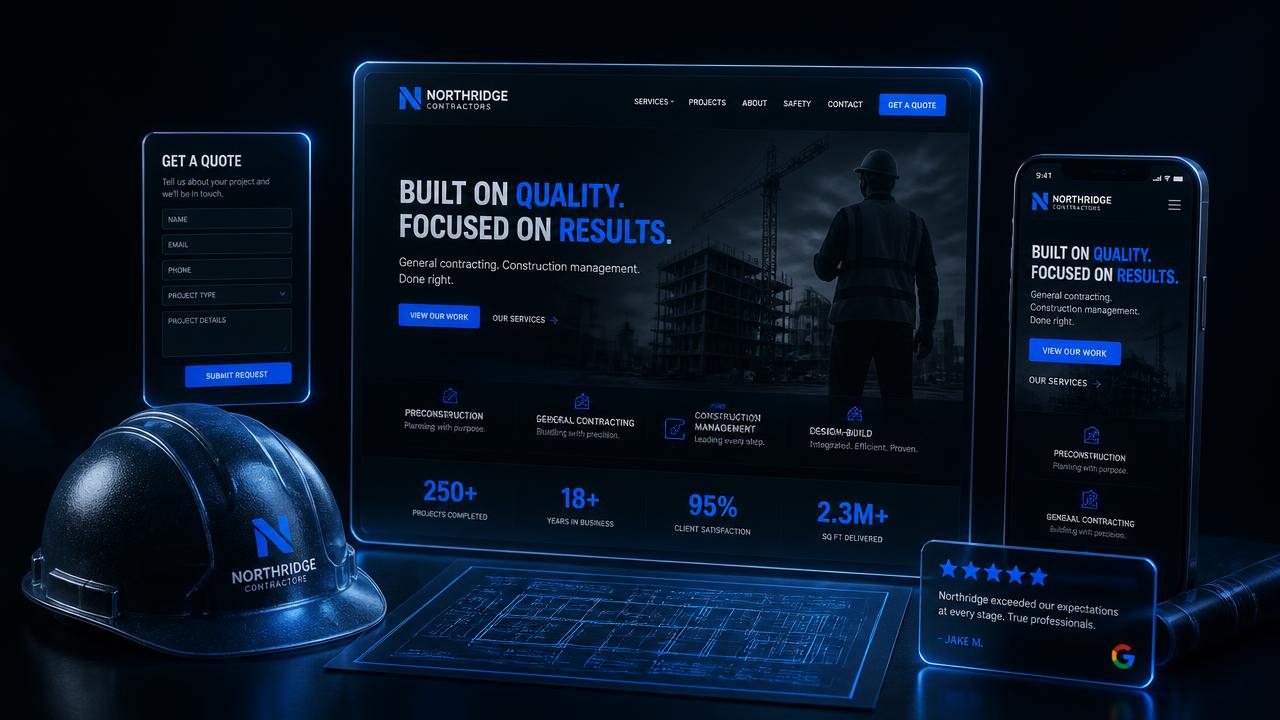
Most contractor websites are losing jobs before the phone ever rings. The homepage is a stock photo of a house, the gallery hasn't been touched since 2019, the quote form goes to an email nobody checks, and the whole thing takes six seconds to load on a phone standing in a driveway. Meanwhile the competitor down the road — same trucks, same crews, worse work — is booked out eight weeks because their site loads instantly, shows twenty real projects, and gets cited when someone asks ChatGPT who the best contractor in town is.
This guide covers what modern contractor website design actually requires in 2026: real pricing, the page architecture that ranks in local search, the structured data that gets you into AI answers, the conversion patterns that produce estimate requests instead of tire-kickers, and how to evaluate a vendor before you hand over a deposit.
Quick answer: what does a contractor website cost and include?
A modern contractor website costs $1,000 to $5,000 as a fixed-price custom build for most residential and commercial contractors, and $10,000+ for multi-location or multi-division companies. It must include a mobile-first custom design, one dedicated page per service, one page per city or service area you actually work in, a real project gallery with before/after photos, license and insurance proof, Core Web Vitals in the green, LocalBusiness and Service JSON-LD structured data, and a server-side quote form with verified delivery and instant notification. Anything less is a business card, not a lead engine.
Why contractors are different from every other vertical
Three things shape every decision in construction web design, and generic template shops miss all three.
**Your buyer is standing outside, on a phone, in the sun.** Mobile is not a checkbox — it is the entire experience. If the tap targets are small, the phone number isn't one tap, or the hero image is a 4MB JPEG, you lost the job to whoever loaded first.
**Trust has to be proven, not claimed.** Homeowners are handing a stranger a five-figure check and a key to their house. "Quality craftsmanship since 1998" proves nothing. License numbers, insurance certificates, bonded status, warranty terms, real crew photos, and twenty finished projects prove everything.
**Demand is intensely local and often urgent.** Roof leak, no A/C, burst pipe. Search happens within a five-mile radius and the decision happens in minutes. Your site has to win a local pack and answer the question fast.
The page architecture that actually ranks
Search engines and AI answer engines both reward specificity. A single "Services" page listing ten trades will never outrank ten dedicated pages, because a page can only be topically excellent about one thing.
One page per service
Build a distinct URL for every job type you genuinely want more of — `/services/kitchen-remodeling`, `/services/roof-replacement`, `/services/commercial-build-out`. Each needs 800 to 1,500 words answering what homeowners actually ask: what the process looks like, how long it takes, what it typically costs, what permits are involved, what happens on day one. Thin 150-word stubs dilute your authority instead of building it.
One page per service area
"Contractor near me" and "roofing company in Coral Gables" are how people search. Give each city, suburb, or county its own page with locally specific content — permit quirks, HOA requirements, climate considerations, projects you completed there, and a distinct NAP block. Do not clone one paragraph and swap the city name; Google has recognized that pattern for a decade.
A project gallery that functions as evidence
The gallery is often the highest-intent page on a contractor site. Each project should be its own entry with before and after photos, the scope, the timeline, the neighborhood, and ideally the rough budget band. Twenty documented projects beat two hundred unlabeled photos every time.
The supporting layer
- **Proof page**: license numbers, insurance certificate, bonding, manufacturer certifications, association memberships, awards.
- **Reviews**: pulled live from Google, with the aggregate rating marked up in schema.
- **Financing**: if you offer it, give it a page — it converts the "can't afford it yet" segment.
- **FAQ**: the twenty questions your office answers on the phone every week, written out.
- **Careers**: in a labor-constrained market, your site is a recruiting tool.
Contractor website design cost in 2026, by tier
Here is what the market actually looks like, and what we charge at AtomikEngine.
Business — $1,000
A fast, custom five-to-seven page site for a single-trade contractor or a new company that needs to look legitimate immediately. Mobile-first design, core service pages, gallery, quote form with verified delivery, local SEO foundations, and schema.
Professional — $2,500
The right fit for most established contractors. Everything above plus dedicated pages per service and service area, a structured project gallery, review integration, expanded content, and a full technical SEO and GEO build so you show up in Google and in AI answers.
Performance — $5,000
For contractors competing in a crowded metro. Advanced conversion architecture, landing pages built per campaign, financing and estimator tools, CRM integration so leads land where your team already works, analytics and call tracking, and content built around the keywords that produce jobs.
Enterprise — $10,000+
Multi-location or multi-division construction companies. Custom architecture, per-location sites or subfolders, project management and client-portal integrations, AI intake agents that qualify leads 24/7, and ongoing performance engineering.
Templated DIY builders run $20 to $60 a month and will cost you far more than they save in lost jobs. Legacy agency retainers of $500 to $2,000 a month often rent you a template you never own. Fixed-scope custom builds are the honest middle.
What actually converts a visitor into a booked estimate
Traffic is not the goal. Booked estimates are. These are the patterns that move the number.
**Speed first.** Every second of load time costs conversions. Serve modern image formats, render on the edge, and keep the largest contentful paint under 2.5 seconds on a mid-range phone over LTE.
**One tap to call, one tap to quote.** A sticky mobile bar with "Call" and "Get Estimate" outperforms any hero redesign you can imagine.
**Ask for less.** Name, phone, ZIP, and job type is enough to start. Every extra required field costs you leads. Collect the rest on the call.
**Show the crew.** Real photos of real people in branded shirts beat stock imagery by a wide margin on a trust-driven purchase.
**Set the response expectation.** "We respond within one business day" converts better than silence — and then you have to actually do it. Speed to lead is the single most under-optimized part of most contracting businesses.
**Instrument everything.** Call tracking, form-submission events, and source attribution. If you can't tell which page produced the job, you can't invest in the right one.
Ranking in Google in 2026
Local search for contractors comes down to four levers.
**Google Business Profile.** Correct primary category, complete service list, service-area definition, weekly photo uploads, and a steady flow of reviews. This is still the highest-ROI hour you will spend.
**NAP consistency.** The exact same business name, address, and phone across your site, GBP, and the major directories. Inconsistency directly suppresses local rankings.
**Core Web Vitals.** Green LCP, INP, and CLS. Most WordPress contractor sites fail here because of plugin bloat and unoptimized photo galleries — the exact assets contractors need most.
**Content depth.** Service pages, city pages, and answer-style articles that address the questions homeowners search before they buy.
Ranking in AI search: GEO for contractors
A growing share of "who should I hire" research now starts in ChatGPT, Google AI Overviews, Perplexity, and Gemini. Those systems do not rank ten blue links — they synthesize an answer and cite a handful of sources. Generative engine optimization is how you become one of them.
**Answer the question in the first paragraph.** AI systems extract self-contained passages. A section that opens with "A roof replacement in South Florida typically costs $9,000 to $25,000 depending on material and square footage" is quotable. One that opens with "When considering your roofing options..." is not.
**Use question-shaped headings.** "How much does a kitchen remodel cost in Miami?" matches how people prompt.
**Publish specifics.** Real price bands, real timelines, real permit steps. Vague marketing copy never gets cited; concrete facts do.
**Ship structured data.** `LocalBusiness` or the specific subtype (`RoofingContractor`, `HVACBusiness`, `Plumber`, `Electrician`, `GeneralContractor`), plus `Service`, `FAQPage`, `AggregateRating`, and `BreadcrumbList`. Structured data is how machines confirm what you do and where.
**Keep an llms.txt and clean HTML.** AI crawlers parse text, not JavaScript-only interfaces. Server-rendered HTML is a prerequisite for being read at all.
**Build off-site consensus.** AI answers weight what multiple sources agree on. Consistent listings, reviews, and mentions across the web make you the safe answer.
How to evaluate a contractor web design vendor
Ask these before you pay a deposit.
- **Do I own the site outright?** If leaving means losing the site, it is a rental.
- **What is the mobile PageSpeed score of your last three builds?** Ask for URLs, then check yourself.
- **Is the quote form delivery verified?** Ask how you'll know a submission failed. Most contractors have silently lost leads for months.
- **Is the scope and price fixed?** Hourly change orders are where budgets die.
- **What schema will you ship?** If they can't name the types, they aren't doing GEO.
- **Who writes the content?** AI-generated filler about "quality craftsmanship" ranks for nothing.
Frequently asked questions
How much does a contractor website cost?
Between $1,000 and $5,000 for most contractors as a fixed-price custom build, and $10,000+ for multi-location construction companies. Monthly template subscriptions cost less up front and far more in lost jobs.
How long does it take to build?
Two to six weeks for most builds, depending on how quickly you can supply photos, license details, and service descriptions. Content gathering — not development — is almost always the bottleneck.
Should contractors use WordPress?
You can, but plugin bloat makes Core Web Vitals hard to pass and creates a permanent security-update burden. We build on a modern edge-rendered stack, which is faster by default and has no plugin attack surface.
Do I need a separate page for every city I serve?
For every city you genuinely work in and want jobs from, yes — with real, locally specific content. Do not mass-produce hundreds of near-duplicate city pages; that pattern gets filtered.
Will a new website actually get me more jobs?
A new site alone is not a lead source. A fast, well-structured site plus a complete Google Business Profile, real reviews, service and city pages, and fast response to inbound leads is. The website is the conversion layer of that system.
The bottom line
In 2026 a contractor website has to do three jobs at once: load instantly on a phone in a driveway, prove you are licensed and competent within about five seconds, and be structured clearly enough that Google and AI answer engines can recommend you. Most contractor sites do none of them. That gap is the opportunity.
Atomik Engine Services
Engineered growth, end to end.
We ship the systems behind everything in this article — websites, SEO/GEO, and AI automation — on a modern edge stack with fixed scope and transparent pricing.
Ready to build?