Miami Web Design in 2026: Why a Modern Website Wins More Local Business
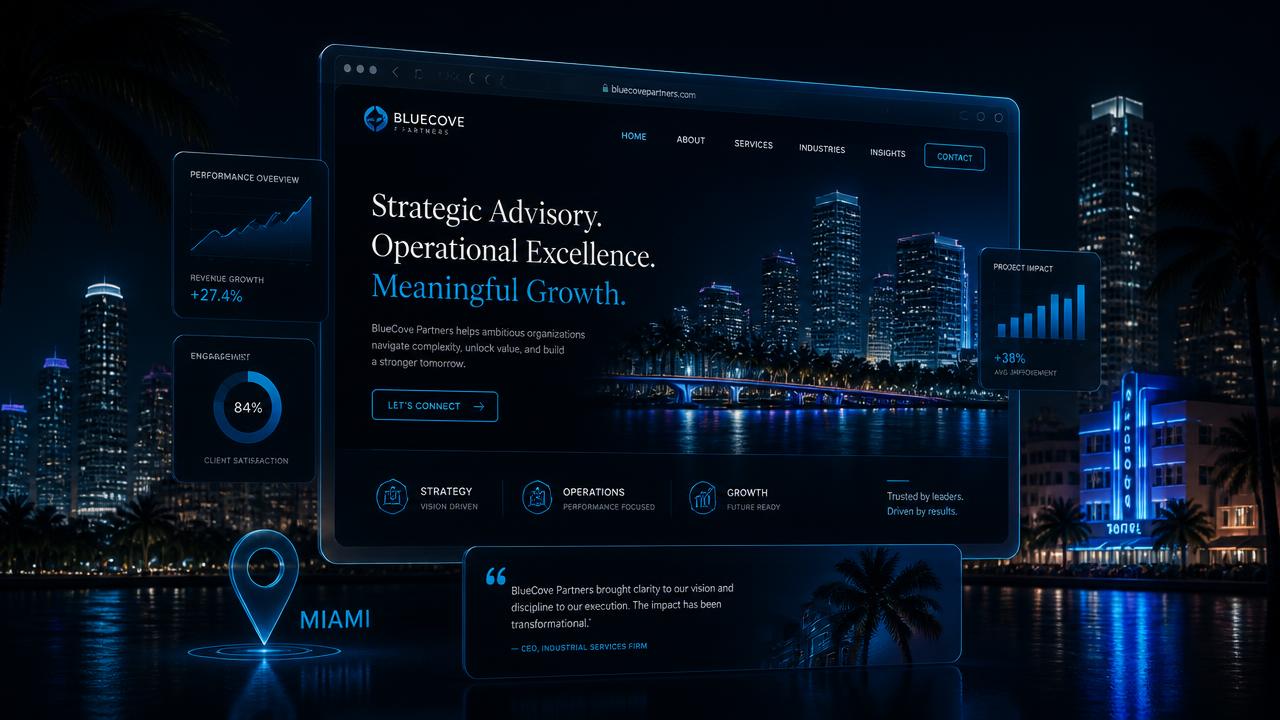
Miami is one of the most competitive small-business markets in the country. Between Brickell, Doral, Coral Gables, Wynwood, Kendall, and Miami Beach, almost every service category has dozens of businesses fighting for the same searches — and most of them are still running websites built five to ten years ago on templates that load slowly, look dated on a phone, and give Google nothing to work with.
That gap is the opportunity. In a market this crowded, a modern website is not a branding exercise. It is the cheapest competitive advantage available to a Miami business, because the bar your competitors set is genuinely low.
Quick answer: what does a modern website do for a Miami business?
A modern website helps a Miami business by loading in under two seconds on mobile LTE, ranking in local Google results and the Map Pack for neighborhood-level searches, serving both English and Spanish audiences, capturing leads through fast forms and instant follow-up, staying secure and compliant, and being structured so AI search engines like ChatGPT, Perplexity, Gemini, and Copilot can cite it. In Miami, professionally built sites typically run $1,000 to $10,000+ depending on page count, integrations, and marketing scope.
1. Local search in Miami is won on speed and structure, not on more pages
Google's local results are heavily weighted toward relevance, distance, and prominence. Prominence is where most Miami sites lose. If your site is slow, has thin service pages, and lacks structured data, Google has no reason to trust you over the firm two blocks away with the same five-star average.
What actually moves local rankings:
- A dedicated page per service, not one "Services" page listing eight things in bullet points
- Neighborhood and city pages with real content — Brickell, Doral, Coral Gables, Aventura, Hialeah — not doorway pages with the city name swapped
- LocalBusiness structured data with your real NAP (name, address, phone) matching your Google Business Profile character for character
- Core Web Vitals in the green on mobile, because most Miami local searches happen on a phone
- Embedded reviews and case detail that prove prominence rather than assert it
2. Mobile speed is the single biggest conversion lever
Local intent traffic is mobile traffic. Someone whose AC died in August is searching on a phone, in the heat, with limited patience. Every additional second of load time measurably reduces the chance they wait around.
Older Miami business sites are usually slow for the same three reasons: a page builder that ships enormous CSS and JavaScript bundles, uncompressed hero images shot at full resolution, and a stack of tracking plugins nobody audited. A modern build fixes all three by default — server-rendered pages on an edge network, images compressed and sized at build time, and no plugin layer at all.
The result is not subtle. Moving a service business site from a four-second load to a sub-two-second load routinely changes lead volume more than any ad budget adjustment at the same spend.
3. Bilingual reach is a Miami-specific advantage most sites waste
More than half of Miami-Dade residents speak Spanish at home. Most local business websites either ignore this entirely or bolt on a browser translation widget that produces awkward copy and gives Google nothing to index.
Done properly, bilingual means real Spanish URLs with their own titles, descriptions, and hreflang tags — separate indexable pages, professionally written rather than machine-translated. That means you show up for Spanish-language searches your competitors are not even entering, and Spanish-speaking prospects land on a page that reads like it was written for them, because it was.
This is one of the highest-ROI decisions available specifically to Miami businesses, and it costs far less than the traffic it unlocks.
4. A modern site turns visitors into scheduled conversations
Traffic is not the goal. Booked calls are. Most older sites treat the contact form as an afterthought: a long form, buried on a separate page, that emails an inbox nobody watches on weekends.
What a modern lead path looks like:
- A short form above the fold on every service page — name, contact, and what they need
- Optional preferred date and time so the first reply can propose a real slot
- Instant confirmation on screen plus an automatic email to the prospect, not silence
- Server-side notification to your team the moment it submits, with retries so a lead never disappears
- Optional AI chat that answers pricing and scope questions at 11pm and captures the contact anyway
The difference between a 6% and a 12% form conversion rate is not more traffic — it is a shorter form, faster pages, and follow-up that happens in seconds instead of days.
5. AI search is already sending Miami businesses leads
A growing share of high-intent research now starts in ChatGPT, Perplexity, Gemini, or Copilot rather than a search box. "Who are the best commercial roofers in Miami?" gets answered with a short list of cited sources — and being on that list is a function of how machine-readable your site is.
Generative engines favor pages that: render content server-side rather than after JavaScript execution, answer the question directly in the first paragraph, use clean heading hierarchy, publish explicit pricing and scope rather than "contact us for a quote," carry structured data (LocalBusiness, Service, FAQPage), and load quickly for crawlers.
Practically, that means the same engineering that makes your site fast for humans is what makes it citable by AI. A site built for one is built for the other.
6. Trust and security are conversion features in a high-fraud market
South Florida buyers are cautious, and they should be. A site with a broken padlock, a 2016 copyright date, stock photography that appears on ten competitor sites, and no clear address will lose to a slower competitor that looks legitimate.
The trust checklist is short: valid HTTPS everywhere, real photography or bespoke visuals, a physical service area stated plainly, verifiable reviews, current privacy and terms pages, and accessible contrast and tap targets so the site works for everyone. None of this is expensive. All of it is visible in the first five seconds.
7. What modern web design actually costs in Miami
Miami pricing ranges widely because "website" describes anything from a one-page template to a fully integrated lead engine. Here is how we scope it at Atomik Engine, with fixed pricing and no hourly surprises:
- **Business Website — $1,000.** A fast, modern multi-page site for a local business: core service pages, mobile-first design, lead form, on-page SEO, and analytics. The right starting point for most Miami service businesses.
- **Professional Website — $2,500.** Expanded page count, custom design system, deeper SEO structure, service and location pages, blog setup, and stronger conversion paths.
- **Performance Website — $5,000.** Built for lead volume: advanced schema, GEO/AI search optimization, integrations, automation, and CRO-focused layouts backed by measurement.
- **Enterprise Website — $10,000+.** Multi-location or multi-service operations, custom applications, bilingual builds, portals, and bespoke integrations.
For context, a cheap $300 template costs far more over two years in lost leads than the gap between it and a $1,000 professional build. And a $25,000 agency retainer rarely buys a Miami service business anything the $2,500 tier does not already deliver.
8. Marketing after launch is what compounds
A new website is a starting line. What grows a Miami business over the following year is consistent execution: local SEO and Google Business Profile management, content that answers real buyer questions, review generation, and — where the math works — paid search on high-intent terms. Note that ad spend is separate from management fees; any agency that blurs the two is hiding something.
The compounding effect is real. A fast, well-structured site makes every marketing dollar work harder, because the traffic you buy or earn actually converts when it lands.
Frequently asked questions
How long does a Miami website build take?
Most business and professional builds ship in two to four weeks once content and brand assets are in hand. Performance and enterprise builds with integrations typically run four to eight weeks.
Do I need a separate Spanish version of my site?
If a meaningful share of your customers are Spanish-speaking — which in Miami-Dade is most consumer and home-service categories — yes. Real translated pages, not a widget.
Will a new website actually improve my Google rankings?
A rebuild alone improves technical signals: speed, crawlability, structure, and schema. Sustained ranking gains come from pairing that foundation with content and local SEO over the following months.
Do you only work with Miami businesses?
We are based in Miami, Florida and work with clients across the United States. Local clients get the added benefit of in-market knowledge and on-site work when it helps.
What is the cheapest way to get a modern website?
Scope tightly. Launch with the pages that generate revenue, skip the ones that flatter the brand, and expand once you have data. That is exactly how our $1,000 Business tier is designed.
The bottom line
In Miami, most businesses are competing with a website that is slower, less structured, and less trustworthy than it should be. Fixing that is not a design project — it is a revenue project, and it is one of the few investments with a measurable payback window.
If you want a straight assessment of what your current site is costing you, tell us your industry and goals and we will scope it honestly.
Atomik Engine Services
Engineered growth, end to end.
We ship the systems behind everything in this article — websites, SEO/GEO, and AI automation — on a modern edge stack with fixed scope and transparent pricing.
Ready to build?