How to Get Business Clients in Miami: The 2026 Lead Generation Playbook
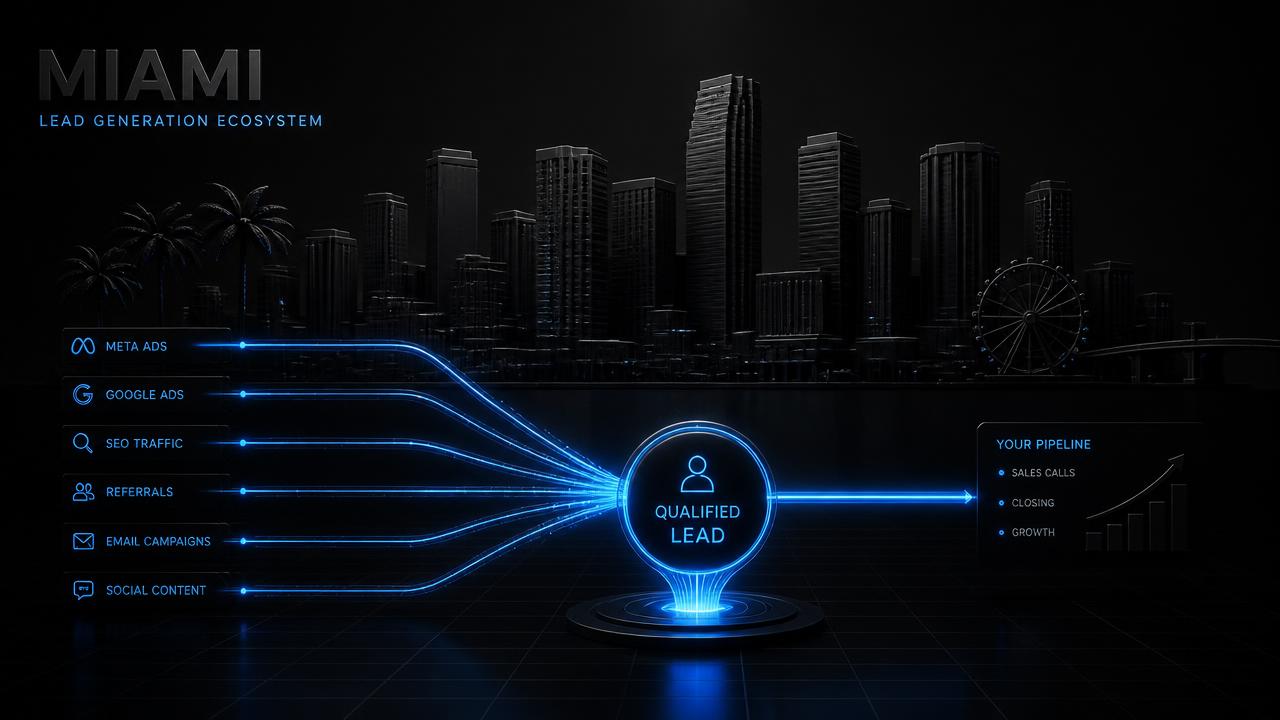
Miami is one of the most competitive small-business markets in the United States. More than 500,000 businesses operate across Miami-Dade, buyers are bilingual, referral-driven, and mobile-first, and new competitors launch every week. Getting clients here is less about hustle and more about building a system that captures demand that already exists.
This guide is the playbook we use with Miami clients: where local buyers actually search, the channels that produce booked calls, what each one costs, and a 30-day plan you can start this week.
Quick answer
The fastest way to get business clients in Miami in 2026 is to combine three things: a fast, conversion-focused website that ranks for local searches, a claimed and actively managed Google Business Profile with steady reviews, and an instant-response system (AI chat plus follow-up) so no inbound lead waits more than five minutes. Paid search and referral partnerships accelerate that base — they do not replace it.
Atomik Engine builds modern professional websites in less than 7 days, with SEO, GEO, and AI lead capture built in from day one.
1. Understand how Miami buyers actually search
Miami buying behavior has three traits that change your strategy.
- Bilingual search. A large share of high-intent queries happen in Spanish. If your site, Google Business Profile, and ads only exist in English, you are invisible to a big part of the market.
- Neighborhood-level intent. People search Brickell, Doral, Coral Gables, Kendall, Hialeah, Wynwood, Aventura, and Miami Beach — not just 'Miami'. Pages built around service plus neighborhood convert far better than one generic city page.
- Mobile and instant. Most local searches happen on a phone, and the business that responds first usually wins. Speed of reply beats polish of pitch.
2. Fix the foundation: your website
Every channel below sends traffic somewhere. If that destination is slow, dated, or unclear, you pay for clicks and lose the client. Before spending a dollar on ads, make sure your site does five things.
- Loads in under two seconds on 4G, because most Miami traffic is mobile.
- States what you do, who you serve, and where, above the fold.
- Offers one obvious next step: call, book, or request a quote — repeated throughout the page.
- Has dedicated service pages and neighborhood pages, so Google has something specific to rank.
- Captures leads 24/7 with a short form plus an AI assistant that answers questions and books appointments after hours.
A modern build with these fundamentals typically pays for itself in one to three closed clients, depending on your average deal size.
3. Own local search (Google Business Profile + local SEO)
For most Miami service businesses, the map pack is the single highest-ROI channel. It is also the most neglected.
- Claim and fully complete your Google Business Profile: categories, service areas, hours, service list, and 20+ real photos.
- Ask every satisfied client for a review, by text, within 24 hours of delivery. A steady drip of reviews outperforms a burst.
- Reply to every review, in the language it was written in.
- Keep your name, address, and phone identical everywhere online — website, Google, Yelp, Apple Maps, chamber listings, industry directories.
- Publish one local page per core service and per key neighborhood you serve, with real details, not spun text.
Local SEO compounds. It usually takes 60 to 120 days to move, then keeps producing leads at near-zero marginal cost.
4. Get cited by AI search (GEO)
A growing share of Miami buyers now ask ChatGPT, Perplexity, or Google's AI Overviews for recommendations before they ever open a search results page. Generative engines cite sources that are clearly structured and factually specific.
- Answer real questions directly on your site, with a short factual answer near the top of the page.
- Publish concrete numbers: prices, timelines, service areas, credentials.
- Add structured data (LocalBusiness, Service, FAQPage) so machines can read your business.
- Keep an FAQ page and keep it current.
This is Generative Engine Optimization. Businesses doing it in Miami right now are few, which is exactly why it is a competitive advantage this year.
5. Paid channels that work in Miami
Paid traffic is how you buy demand while SEO matures. Two channels carry most of the results.
- Google Search Ads for high-intent keywords like 'emergency AC repair Doral' or 'personal injury attorney Miami'. Expensive per click, but the intent is immediate. Budget $1,500 to $5,000 per month to get meaningful data.
- Meta Ads for service businesses with visual proof or offers — med spas, restaurants, contractors, real estate. Cheaper clicks, colder audience, so the landing page and follow-up matter more.
Run both in English and Spanish. Send traffic to a dedicated landing page, never your homepage, and track calls and form fills as conversions or you are flying blind.
6. Referrals and partnerships (still the strongest channel in Miami)
Miami runs on relationships. The most reliable pipeline most local businesses have is a small network of complementary partners who send work back and forth.
- List the five business types that serve your client before or after you — a roofer and an insurance adjuster, a CPA and a business attorney, a realtor and a property manager.
- Meet three of them per month, in person, and make the first introduction yourself.
- Give partners a simple way to refer: a link, a landing page with their name on it, or a shared intake form.
- Ask past clients for a specific referral, not a general one: 'Do you know another restaurant owner in Wynwood who needs this?'
Chambers, BNI groups, industry associations, and neighborhood business alliances are still worth the time in Miami-Dade — but only if you treat them as partner sourcing, not as an audience to pitch.
7. Respond in under five minutes, every time
Studies of inbound lead response consistently show that contacting a lead within five minutes dramatically increases the odds of qualifying them versus waiting an hour. In a market as competitive as Miami, the second caller usually loses.
- Route every form fill to a text message and an email, immediately.
- Use an AI assistant to answer instantly at night and on weekends, in English and Spanish, and to book directly onto your calendar.
- Follow up at least five times across text, email, and call before marking a lead dead.
This one change often produces a larger revenue lift than any new marketing channel, because it captures leads you are already paying for.
What it costs to build a Miami client engine
- Website that converts: $1,000 to $10,000+ one time, depending on scope.
- Local SEO and content: $500 to $3,500 per month.
- Google and Meta ads: $1,500 to $10,000 per month in media, plus management.
- AI chat and automated follow-up: $1,500 to $15,000 to build, $50 to $500 per month to run.
- Referral and partnership work: your time, plus a small budget for events.
Most Miami small businesses should start with the website, Google Business Profile, and instant response. Add paid traffic once the destination converts.
Your first 30 days
- Week 1: Audit or rebuild the website. Fix speed, clarify the offer, add clear calls to action and an AI assistant.
- Week 2: Complete the Google Business Profile, launch a review request process, and fix all directory listings.
- Week 3: Publish three service pages and two neighborhood pages. Add FAQ content and structured data.
- Week 4: Launch one tightly targeted Google Ads campaign, set up conversion tracking, and book three partner meetings.
Repeat months two and three. Expect early wins from ads and instant response, and compounding organic leads from month three onward.
Frequently asked questions
What is the fastest way to get clients in Miami?
Paid search plus an instant-response system. Ads can produce qualified calls within days, but only if the landing page is fast and someone answers within minutes.
Do I need a Spanish version of my website?
In most Miami-Dade markets, yes. At minimum, offer Spanish on your core service pages, your Google Business Profile, and your chat assistant.
How long does local SEO take in Miami?
Typically 60 to 120 days for movement in the map pack and 4 to 6 months for competitive service keywords, assuming consistent content and reviews.
How much should a Miami small business spend on marketing?
A common benchmark is 7 to 10 percent of revenue for established businesses, and more during a growth push. Put the first dollars into the website and local search before scaling ads.
How Atomik Engine helps
Atomik Engine is a Miami-based digital agency that builds the entire client-acquisition engine described above: a fast modern website, local SEO and GEO so you get found in Google and AI search, and AI automation that answers, qualifies, and books leads around the clock.
- Website Design — Business, Professional, Performance, and Enterprise builds starting at $1,000, shipped in under 7 days.
- Digital Marketing — local SEO, GEO, content, and neighborhood landing pages engineered to rank in Google and be cited by AI search.
- AI Development — bilingual chat agents, lead qualification, and automated follow-up wired into your calendar and CRM.
Fixed scope, transparent pricing, and you own the code. View packages and buy online, or book a free discovery call and we will map your Miami lead engine in 30 minutes.
Atomik Engine Services
Engineered growth, end to end.
We ship the systems behind everything in this article — websites, SEO/GEO, and AI automation — on a modern edge stack with fixed scope and transparent pricing.
Ready to build?